Reviews and features
Read the following review and feature on Capital:
Guardian review by Sam Wollaston
London Evening Standard: five things you need to know about Capital
1) What positive points does the review pick out about Capital? What criticisms are made - either of the TV drama or the original novel?
Both reviews highlight how the TV drama reflects the life of many Londoners accurately by showing modern struggles in an authentic light.
2) What references can you find in the reviews and feature to the idea Capital is a 'state-of-the-nation' drama? How does it capture modern-day London?
"(house prices, obviously still insane, but about a third of Pepys Road)" - suggests how even though most of the audience don't live in the same area as where the show takes place, they can still find the characters struggles relatable.
"managed to squeeze an incredible amount into one street, one book, and then further squeeze into three hours of television. A lot of the important stuff" - This quote suggests how although the show is short, with only 3 episodes, it still manages to illustrate the key issues in London
"3) The TV adaptation is set in present day" - This is features the idea that Capital is a state of the nation drama as it suggests how the novel, set in 2008, still is applicable in the modern day, 7 years later, which shows the issues of Britain in a genuine manner.
Trailer analysis
Watch the trailer for Capital:
1) How does the drama use camerawork to capture London life?
Watch the trailer for Capital:
1) How does the drama use camerawork to capture London life?
The long shot and bird eye views capture life in London as it highlights the setting and its importance due to the long history London has had with immigration.
2) How does the trailer introduce the different narrative strands suggesting tension or enigma in the 40-second running time?
It shows all the different characters in their own homes suggesting their own, hidden from others, life problems but links them together through props that they receive such as the parcels and cards.
Capital in Media Magazine
Issue 83 of Media Magazine has a feature exploring Capital as a media product. Read ‘We Want What You Have’ in MM83 (p10). You'll find our Media Magazine archive here - remember you'll need your Greenford Google login to access. Answer the following questions:
1) What does the article suggest about the 'state of the nation' genre and how Capital is an example of this?
It suggests that the state of the nation genre tends to show politics and social quality of society and says that Capital is an example of this as it demonstrates the result of the banking crash in 2008.
2) What does the article suggest regarding the setting of Capital?
It suggests that London was a good place to set the show as its a diverse city with complex problems.
3) What are the major themes in Capital and what does the article suggest regarding the impact of money on communities?
The theme of economy suggests that it causes communities to be desperate for homing, especially in fancy, big houses.
4) What different representations in Capital are discussed in the article?
They highlight how in the show banks are represented as evil whereas the poor are represented as good.
5) What does the final section of the article suggest regarding genre and overall message of the drama?
The genre has aspects of social realism and state of the nation which shows its overall message as wanting to highlight the issues of Britain with its economy.
Capital Media Factsheet
Use our Media Factsheet archive on the M: drive Media Shared (M:\Resources\A Level\Media Factsheets) or on Google Drive here (you'll need your Greenford Google login) to find Media Factsheet #194 on Capital (BBC TV Drama).
Read the whole of Factsheet and answer the following questions:
1) What does the factsheet say about the characters on the first page?
Characters are used to highlight the tension between different cultures in modern day Britain.
2) Focusing on the industrial contexts, how does Capital help the BBC meet its obligations as a public service broadcaster?
It provides information about the country, it entertains people through its narrative such as the enigma codes and it educates the people of the past economic crash.
3) What do we learn about the ownership structure for production company Kudos?
It is a subsidiary for Endemol Shine UK.
4) How can David Hesmondhalgh's ideas in The Cultural Industries be linked to Capital and Kudos?
The fact it is a subsidiary demonstrates how conglomerates spread risk by buying other companies for a secure cash flow from other sources.
Conventions of crime include enigma codes, resolution of a mystery, teamwork and betrayal.
Conventions of social realism include accurate representations of the UK, wide shots used for location and shooting at an authentic location.
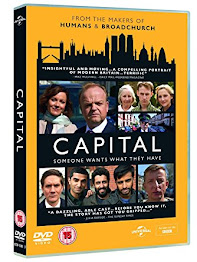
6) How does the factsheet analyse the DVD packaging and what this communicates to the audience?
The DVD cover is the same for most promotional content making it recognisable for many audiences. The silhouette of London creates a marker that establishes and suggests that the genre of this show has something to do with Britain and social realism.
7) Look at page 5 of the factsheet. Choose one of the audience theories in the table and apply it to Capital.
Uses and Gratification:
Personal Identity - Ensemble cast provides a range of representations for audiences to relate to
Personal Relationships - The multi-strand narratives for each character allow us to feel different emotions for different characters such as sympathy
Diversion - Many may watch this show to escape their world and see other peoples lives
Surveillance - Get information on the countries state and issues
8) What does the factsheet suggest regarding binary oppositions in Capital?
Binary oppositions are reflected through contrasts of the rich and poor, 2 opposite sides of the same spectrum.
Representations: close-textual analysis
Capital offers a range of fascinating representations - from London and asylum seekers to capitalism and inequality. You need to be able to confidently discuss these issues in the context of 2015 London - with reference to key scenes from episode 1. Representations include: London, family, gender, ethnicity, religion, immigration, asylum, inequality, wealth, capitalism, aging and more.
These are our notes from this year analysing the episode in class. There are also these notes from a previous year analysing the clips in case this is useful. Use this to help with this element of the case study. You'll need your Greenford Google login to access the document.
1) Write an analysis of the representations in each of the key scenes from episode 1 we studied in the lesson:
Scene 1: opening sequence 00:30 – 4.49
1) Write an analysis of the representations in each of the key scenes from episode 1 we studied in the lesson:
Scene 1: opening sequence 00:30 – 4.49
The setting of London is important due to the history it has with immigration and housing prices. The show uses stereotypes, such as the conventional representation of a British family, to represent the different people in a short cut but to reflect how people may see one another. These both create and show issues with racism and housing in the UK.
Scene 2: work in the City 6.28 – 8.10
The birds eye view of London represents how London is the heart of finance and office work. There is a scene with only white men in the office, including Roger, which reinforces stereotypes. We see issues with capitalism and inequality as woman are not represented to be working as well as people of colour.
Scene 3: “Which of those isn’t absolutely essential?” 14.00 – 15.35
- Gender stereotypes are reinforced
- Represents how privileged the upper-class of Britain are
Scene 4: asylum 18.03 – 19.42 AND 31.10 – 32.40
- Black female lawyer subverts sterotypes
- Reflects problems with Britain's justice system as asylum seekers cannot find help
Scene 5: “What use is 30 grand?” 36.40 – 39.00
- Reflects the privilege of upper class people again
- Sped up editing shows Rogers disconnection with reality
- Clips also show Quentina being exploited
Scene 6: life at the corner shop 40.10 – 42.55
- Arabella meets with Ahmed and they realise they live on the streets which reflects the lack of community in London
- Closeness of Kamal family contrasts Arabella and Roger
- Social class - Arabella is shocked when she is given coriander for free
You can choose which aspects to focus on for each scene: e.g. London, family, gender, ethnicity, religion, immigration, asylum, inequality, wealth, aging etc. Feel free to use bullet points for each scene - a summary of your notes is fine.
2) How does Capital use stereotypes? Do the characters and issues represented in Capital reinforce or subvert the stereotypes we typically see in the media?
You can choose which aspects to focus on for each scene: e.g. London, family, gender, ethnicity, religion, immigration, asylum, inequality, wealth, aging etc. Feel free to use bullet points for each scene - a summary of your notes is fine.
2) How does Capital use stereotypes? Do the characters and issues represented in Capital reinforce or subvert the stereotypes we typically see in the media?
They reinforce stereotypes frequently such as a brown family owning a corner shop. They use these stereotypes to create a short cut for audiences to quickly understand the characters.
Industries and production context
Capital was produced by independent production company Kudos for the BBC. Look at the Kudos website and also read the Kudos Wikipedia page.
1) Who is the parent company for Kudos? What changes of ownership have there been for Kudos? This is an example of conglomerate ownership.
It was bought by Endemol Shine Group UK in 2015 but then it was bought by and now owned by Banijay since 2018.
2) Watch the showreel on the Kudos website. What other TV dramas have Kudos produced and for which channels? What awards have they won?
Capital was produced by independent production company Kudos for the BBC. Look at the Kudos website and also read the Kudos Wikipedia page.
1) Who is the parent company for Kudos? What changes of ownership have there been for Kudos? This is an example of conglomerate ownership.
It was bought by Endemol Shine Group UK in 2015 but then it was bought by and now owned by Banijay since 2018.
2) Watch the showreel on the Kudos website. What other TV dramas have Kudos produced and for which channels? What awards have they won?
They have won two BAFTAs awards and produced River, Law and Order, The Hour and etc.
3) How does Capital help the BBC to fulfil its remit as a public service broadcaster? You may want to look back at our work on public service broadcasting last term.
Its produced by the BBC and meets its remits by educating audiences of the UKs issues, informing them about the state of the country and entertaining them by allowing them to view other peoples lives.
Comments
Post a Comment